Français
 Italiano
 Deutsch
 Español
 Português
The Zippo saga begins in the midst of the American Depression, in a garage on Boylston Street, Pennsylvania, following these few words exchanged in a club between George Grant Blaisdell, co-director of the Blaisdell Oil Company, and one of his friends returning from Austria:
Conquered by this symbol of solidity, Blaisdell initially obtains the distribution rights in the United States for these relatively ugly Austrian lighters, oblong in shape with a cumbersome mechanism and a removable brass lid. Their handling proves to be awkward, and the venture ends in failure.
In an America in a perpetual quest for marked innovation, one year earlier marked by the inauguration of the Empire State Building, the businessman then becomes an inventor.
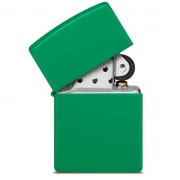
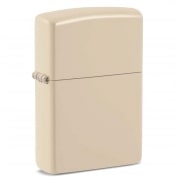
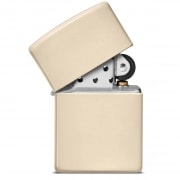
He reworks the shape of the object so that, having become rectangular, it can be opened with one hand. The lid is thus attached to the body by a hinge, then external.
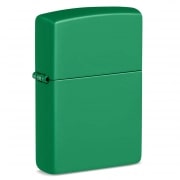
The wick remains protected from wind and rain by a “chimney” pierced with holes, armor that maintains a constant flame and prevents the ambient air to excessively feed combustion. The gasoline, poured directly inside the body of the lighter, soaks a mass of wadding (the Zippo cotton) and the flint, engaged in a tubular conduit, is compressed by a spring which, screwed at its base, pushes it towards the wheel.
This part, the only one whose manufacture is this outsourced era, has parallel grooves, oriented in such a way that they direct the sparks towards the wick head.
Thus appears, in 1932, the first Zippo whose name was dictated to Georges Blaisdell by his fascination for a recent invention; the Zipper, famous in France under the name of its first brand, Eclair zipper.
Curiously enough, however, the word Zips also refers to a former Austro-Hungarian Comitat.But isn't the ancestor of the Zippo Austrian?
And if we let ourselves be carried away by mythology to pre-Columbian America, we discover that the Indians of Nicaragua nicknamed Zippaltonal the god who accompanied their souls to the sky. Zippo wouldn't it thus be a magic word for a creation destined for immortality?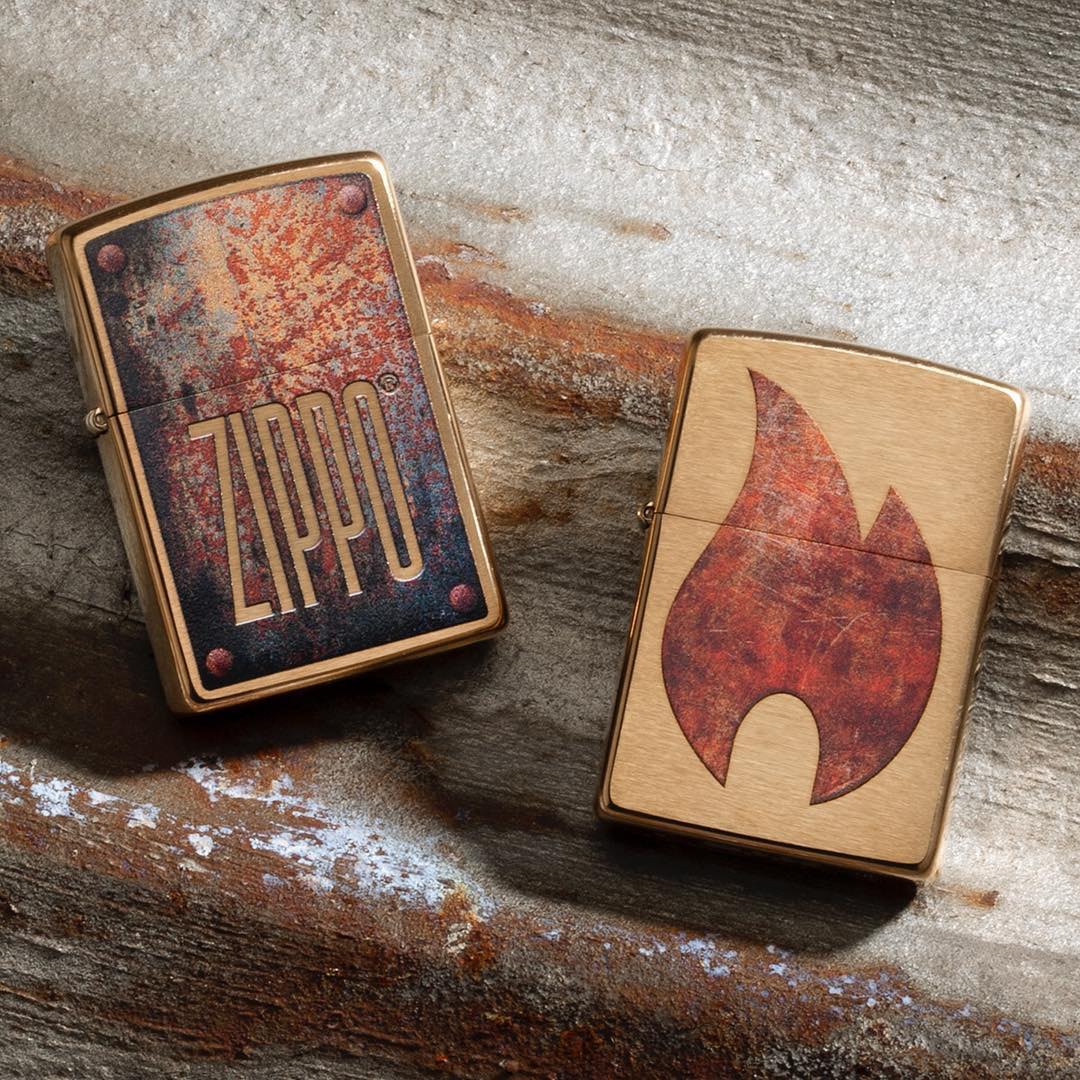
The first monthly report is rather thin: 82 lighters sold for $62.15. The company currently has only six employees, installed in a narrow room located above the brick garage 'Rickerson and Pride'.
Disappointed, but nevertheless persevering, Blaisdell then seeks the complicity of a childhood friend, director of the Bradford bus station. There, he offers his lighters to specialized drivers for the longest routes and loads in exchange for praising them to users.
At the same time, he leaves them on consignment with tobacconists and jewelers, not requiring any return in case of unsold items. Nevertheless, the latter hesitate due to the lack of advertising support.
Thus, as early as 1934, Blaisdell distributes Zippos through a lottery available at tobacconists, pastry shops, and gaming halls.
This lottery is based on a board of 1000 carnations hiding as many numbers.
For 2 cents, the player punches one of these carnations and wins a lighter if he reveals one of the pre-chosen numbers: 200, 400, 600, 800 or 1000.
Twenty other numbers each win 20 cigarettes. 300,000 Zippo were distributed between 1934 and 1940, when such practices were banned.
Another advertising offensive by George Blaisdell was the purchase, in 1937, of a full-page spread in Esquire magazine.
However, this was without taking into account the cramped spacefrom its distribution network and an infrastructure still ill-suited to the fallout from such a campaign. The "Zippo Company" will not even be able to fulfill the orders, which are too numerous compared to the 3,000 dollars borrowed and invested in the operation.
At the same time, the lighter evolves. A double horizontal decorative line appeared in 1933 at opposite corners of the case, and the following year the Zippo was shortened by a quarter of an inch, in line with its current dimensions.
1935 sees the first advertising orders, 200 and 500 pieces respectively, featuring a life insurance company and the Kendall Oil Company, which intend them for their clients and top salespeople.
From that point on, the company establishes itself, launches its first themed series engraved with images of different sports on lighters whose hinge is now internal, and expands by acquiring new offices at 21 Pine Street before consolidating in 1938 at 36 Barbour Street.
It is under this design that, on the eve of the world conflict, a 14-carat solid gold lighter appears, in a shiny or guilloché version, the last must-have before the restrictions.
With the announcement of the war comes indeed the ban on using brass for purposes other than military.
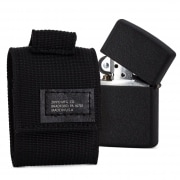
The Zippo then takes on a somewhat sad appearance, produced in porous steel of mediocre quality, covered with a glossy black epoxy paint and then baked in a hot oven to give it a crackled look. The entirety of the production is then delivered to the army until 1945.
From the end of hostilities, silver-plated nickel decorated with stencil designs replaced steel.
The lighters are illustrated with designs drawing on traditional hunting and fishing images: boats, trout, dogs, horses, pheasants …, reassuring values in this post-war period.
The wheel, which no longer meets the required quality, is then produced by the manufacturer using processes that are still kept secret today. The economic recovery also forces the company to restructure itself.
Whereas since 1935 the distribution system was limited to two cigar representatives for whom placing Zippos was only an ancillary activity over a rather vast territory, 1950 is marked by the recruitment of regional managers.
These new managers specifically cover the entirety of the United States and, beyond tobacco shops, expand distribution to drugstores, jewelers, and grocery wholesalers.
It is also the era when Blaisdell opens a factory in Canada, near Niagara Falls.
The Zippo is dressed in leather in various colors and this time is enhanced with a silver model, polished or guilloché…
New war (Korea), new steel lighters until 1953, the date on which this metal gave way to chrome-plated brass.
At the time when The jukeboxes resonate with popular songs to the rhythm of Elvis Presley and Frank Sinatra, the company prospers and sets up its plating department and production units in a building on Congress Street, then consolidates its administrative services in a new building adjacent to the Barbour Street offices.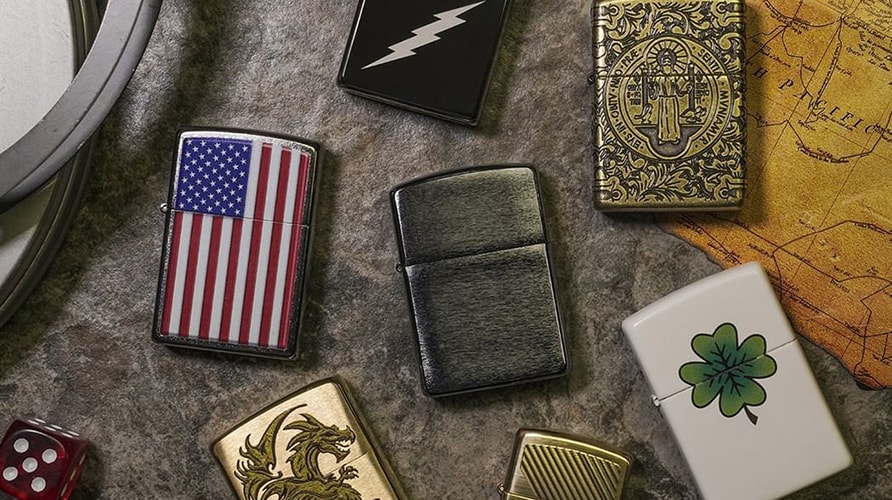
1960 marks the technological rise of the New World and the beginning of space exploration, inspiring Americans with desires for vertical spaces and slender forms. Blaisdell then revisits, in a gold-plated version, his 'slim' (narrow) model created in 1956 and now dedicated to the female clientele.
This narrower Zippo would regularly appear, crafted in more traditional metals alongside the traditional regular ».
Both of them will, over the years, be plated with gold and silver, engraved with advertising logos or various commemorations, dressed in vinyl or coated in acrylic.
When Blaisdell died in 1978, the foundations of his empire were firmly established.
Since then, the company has continued to innovate and, following the example of its founder, adapts to constant technological advances without losing sight of traditional values.
Such a principle is self-evident if one knows that the average seniority the employees of the factory is 25 years.
Each stage of this career is marked by the gift of a case comprising, on one hand, the solid gold replica – flame included – of a Zippo, on the other hand a set of precious stones, diamonds and rubies, symbols of the years spent in the service of the company.
The company also today has the zeal of 1,000 specialists in promotion and advertising, particularly trained in business-to-business sales techniques.
It is only at This price that the management of Zippo Manufacturing Company fully justifies with its own slogan: « Zippo… An American way of life ».
Zippo, a name that has traveled the world. A tall and strong flame that has withstood all storms, a flame… that is reminiscent of the torch of the Statue of Liberty.
Zippo, an object for smokers but also, and above all, a fetish object of America, bearer of dreams, a guarantee of durability, of safetyand of aesthetic perfection.
On the Zippo rests a part of the American dream just as on the Jeep, the Ray-Bans of World War II pilots, or the "beautiful Americans": Cadillac, Studebaker, Chevrolet.
Its original shape, its name, have as much impact in the imagination and memory as King Gillette blue razor blades, the first Remington typewriters, or Singer sewing machines.
It is as legendary as the Winchester or the Colt Peacemaker for the western; the gesture of the Zippo lighting on the sideof the trousers also reminds one of that of the cowboy who draws...
Thus, after half a century of existence, far from being obsolete, the Zippo is still... the king lighter.
(Excerpt from the book by Eric Leguèbe - The Zippo Lighters)
His name is Gilbert Vanel. Thanks to him, the Zippo has regained France.
A collector's item, coveted, the highly prized lighter had almost become impossible to find in the hexagon during the 1960s-1970s. At that time, there were no more American bases in France; SHAPE had moved to Belgium.
To get a Zippo, if you couldn't cross the Atlantic, you had to rely on a possible friend on board a Royal Navy unit or someone likely to embark on the ships of the U.S. Sixth Fleet calling at Toulon.Thus, sometimes, a rare model corresponding to the release of a Hollywood thread, reserved for the "happy few," arrived in Paris.
Passionate about this Zippo, which had become almost mythical, Gilbert Vanel became in 1979 the first official distributor of the brand in France. In a decade of passionate research and persistent contacts, he achieved his dream and the Zippo regained its right to be cited.
'There was the era of sophisticated lighters that corresponded to curiosity for advanced technology and in fact resulted in objects that are too fragile, difficult to maintain, to get repaired… Soon robustness and reliability regained their rights; the time of the Zippo had returned."
The adventure is punctuated by unusual, picturesque, amusing stages. Thus, among his lucky Zippos, he mentions the black shell, limited edition, created for the "Jules" fragrance by Christian Dior.
The success was instantaneous! So much so that it gave the factories in Bradford the idea to relaunch the stock of black lighters on the market.
Yesterday's unsold items are snapped up thanks to Vanel Diffusion; the Zippo has regained its place in the display cases not only of tobacconists but also in prestigious establishments such as Publicis Drugstores and jewelry stores.
Gilbert Vanel himself creates models in pure gold, gold, and silver, and launches new collections with lacquered shells.
The success of Zippo in France is significant when one knows that sales in the United States represent only 10% of the brand's revenue.
France, for its part, is at the head of the market.European thanks to 600,000 copies sold in 1990 (150 different models compared to 3,000 (only 10 models) ten years earlier.
A REAL SUCCESS