Français
 Italiano
 Deutsch
 Español
 Português
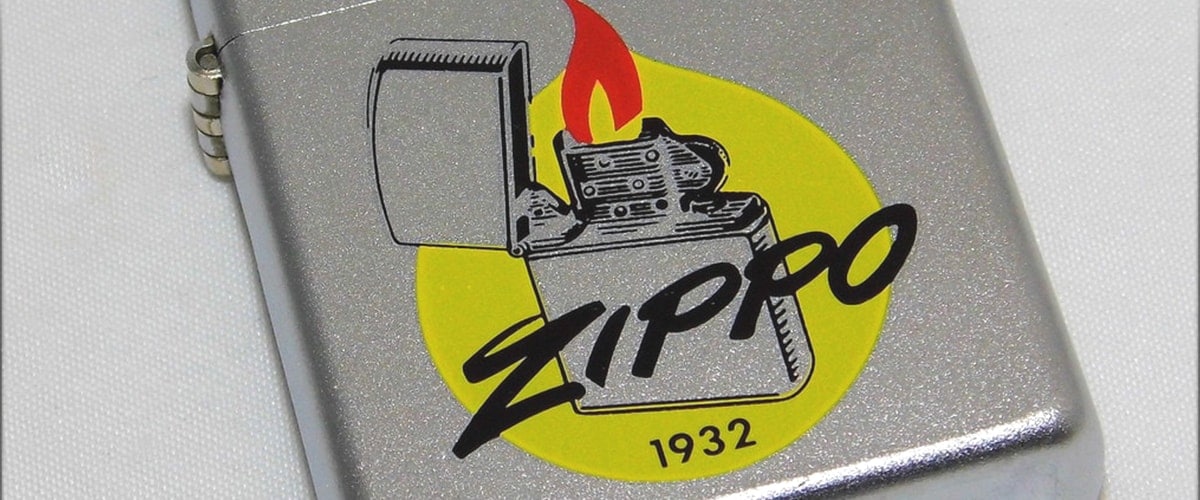
The Zippo is featured as early as 1948 in "Homecoming" by Mervyn Leroy, curiously in the hands of a woman, Lana Turner, partner of Clark Gable.
Donna Reed (another woman!) follows five years later ("From Here to Eternity" by Fred Zinneman - 1953 - Evocation of Pearl Harbor) then the Zippo returns to the more masculine pockets of the Marines during the Battle of Saipan illustrated by "The High and the Mighty" and directed by Raoul Walsh (1954), in those of Lee Marvin on the occasion of "Attack".staged by Robert Aldrich or by Errol Flynn vividly experiencing his "Adventures in Burma".
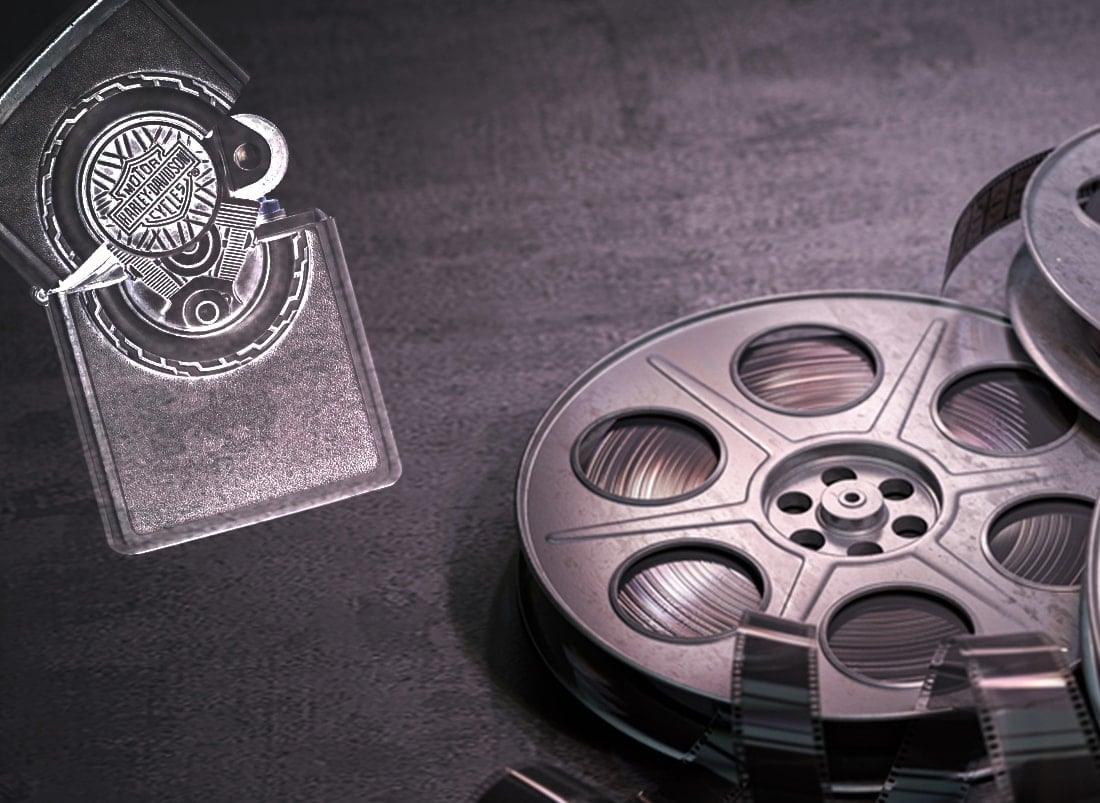
The following decade still honors the creation made in Bradford through, for example, two French works by Jean-Pierre Melville and George Lautner: "Le cercle rouge" (1970) and "La valise" (1973), emphasizing the American "look" of the protagonists.
Since then, the Zippo tends to appear only alongside true adventurers, for a good cause… Thus Lambert Wilson lights up a festival of dynamite in "Bleu comme l'enfer"which allows him to eliminate Tchéky Karyo, and Bruce Willis can, thanks to the Zippo, light his way and move through the ventilation pipes of a burning skyscraper in order to trigger the fire safety system that will prevent the "Die Hard" trap from closing in on him. The Zippo is also the detonator for the "explosive" ending of "Terminator" with Arnold Schwarzenegger and for the equally spectacular ending of the pirates' plane, whose burning fuel tank no longer even gives them " 58 Minutes to Live ».
Finally, under Steven Spielberg's cameras, he will once again save father and son (Sean Connery, Harrison Ford), allowing the former to burn the bonds that hold them prisoner thanks to the lighter taken from the latter's pocket (« Indiana Jones and the Last Crusade »). The last cinematic winks of the Zippo, Michael Douglas's model, stamped with the miniature insignia of the New York police, « C385 », with which the actor burns a $100 bill under the dazed gaze of his Japanese partner (« Black Rain ») and, finally, the image of Eddie Murphy, triumphant and laughing, holding on the stretcher on which he is lying, the Zippo that he finally managed to steal from Nick Nolte, in « 48 Hrs. More ».
Also let's mention the Zippos of Paul Burke, private detective facing Steve McQueen in « The Thomas Crown Affair » by Mickey Rourke, « The Irishman » also known as « Johnny Got His Gun » by Willem Dafoe (« Wild at Heart ») and Power Boothe finally, facing Nick Nolte in « Extreme prejudice".
Such a filmography allows one to measure the extent of the Zippo's impact, whose presence almost single-handedly defines the hero's personality. The Bradford workshops, aware of this stardom, themselves projected cinema onto their product. As early as 1965, a special stamped copper lighter paid embossed tribute to Richard Brooks' "Lord Jim." Following came the "Miami Vice" ("two cops in Miami") and "Mystery Train" films by Jim Jarmusch, not to mention, in the "American Classics" series, the Zippo withHumphrey Boggart's getaway.
Also noteworthy are other themes with a younger or humorous connotation featuring, between 1981 and 1989, the characters of Walt Disney, from Disneyland to Disneyworld, and finally, a model, 1989 version, adorned with a camera and a clapperboard on which it reads: "Hollywood Studio: scene 6, take 4".
Let us, to conclude, give the floor to the director Sydney Pollack, who, coming to Paris for the release of his new film "Havana," praised the Zippo, emphasizing that the Zippo is one of the key elements of American culture, one of its successes. It is the best lighter in the world. It is sturdy, tactilely soft, almost voluptuous. Its weight is perfect. In the continuity of my film "Havana," it contributes to defining the character played by Robert Redford.
The comfort, the elegance of the Zippo correspond, respond to those of cowboy boots, practical in the countryside and not clashing with the elegance of a dressed-up evening. The Zippo might only be practical, it is also decorative. Its beauty lies in the perfect way it fulfills its function and goes beyond it.
Having captivated cinema, the Zippo could not leave creators of graphic literature indifferent. The artists of the golden age of comics therefore followed the trend, such as Alex Raymond, one of the greatest in this field, who places the legendary lighter in the universe of his two classic strips: "Jungle Jim" and "Rip Kirby".
The Zippo then continues its brilliant career in detective comics, in the adventures of "Secret Agent X-9" sketchedby Robert Storm based on an idea by Mel Grafe for "Mike Hammer" created in 1953 by Ed. Robbins. He also reappears in 1970 in the hands of "Johny Hazard" in "Johny the newspaper of the Golden Age," by Frank Robbins, and more generally in the albums of Dupuis editions in the hands of "Buck Danny," "Test Pilot" carrying out a "Top secret" mission in the "Korean Sky" under the pencils of Victor Hubinon on scripts by Jean Michel Charlier.
Just like in cinema, it will also establish itself in " Comics » inspired by the conflicts in Korea and Vietnam. For the latter, the adventure begins with « Tales of the Green Berets » illustrated by Joe Kubert based on the book by Robin Moore and continues with many other series such as « The Nam » (Marvel) whose issue number one was released in December 1986.
The Zippo is still at the forefront of the images in « Vietnam Journal » (Apple Comics) or « Steve Canyon » by Milton Caniff, this time concerning the Korean War.
The ultimate in this field, however, is constituted by the appearance of a fully-fledged hero straight out, in 1943, from the imagination of Tony Di Preta. This character from "Hillmann Periodicals clue Comic" whose hood features a dial as a crest, a masked vigilante just like "The Flash", "Captain America" or "The Fighting Yank", is simply called "Zippo".
Among the distinctive features of this superhero are two other dials, which at his ankles replace the wings of Mercury and, of course, transferred on the chest of his tights, a giant Z not for Zorro but for "Zippo," who lived between January 1943 and May 1947, the duration of fifteen issues.
At the same time, Otto Soglow, father of the "Little King," stages a story in honor of Zippo, against a background of baseball, in Collier's magazine.
About six years later, Sam Cobean dedicates him in turn within the pages of the same Collier's through a true advertising board in comic strip form.
Final tributes, after having intruded In the worlds of cinema and comic books, the Zippo takes on the daily press and appears on January 14, 1987, in the hands of a Ronald Reagan parodying Don Johnson from “Miami Vice,” in the pages of the International Herald Tribune.
A wink this time and an exchange of courtesy also take place during the tribute paid by Zippo to comic books, with the appearance, on a 1950 lighter, of the silhouette of a warship, the " USS Des Moines – CA 134 – featuring superimposed, in the purest tradition of pin-ups for soldiers, the characters of Daisy Mae, the scantily dressed fiancée with a generous neckline from "Li'l Abner," a comic strip by Al Capp.
Finally, her latest conquest, her very noticeable entry into the world of video games thanks to a creation from City Video
Productions; "The What Now Copper" (1990).