Français
 Italiano
 Deutsch
 Español
 Português

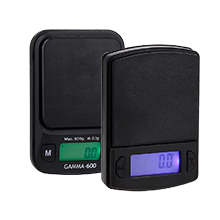
A precision scale can allow you to know a mass to the nearest milligram. However, you still need to know how to calculate its accuracy! There is what is called weighing uncertainty. A focus on this very complex phenomenon that can mislead you.
Using a precision scale in the kitchen or in the laboratory does not require the same criteria. This is why it is important to choose the right model in order to avoid mistakes.
Moreover, there are two types of precision scales classified into two categories: class I and class II.
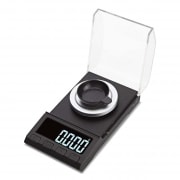
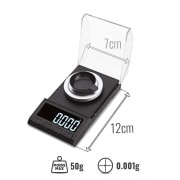
In the first group, we find sharp precision scales, equipped with glass or plastic doors to stabilize the pan and prevent external elements from disturbing the weighing. In the second class, we rather group the classic precision scales, known for their quick results and reliability. These are precision scales designed to reduce uncertainty.
When you weigh a mass, you obtain its weight. The weighing uncertainty is the reasonable margin of error that includes the exact value of that measurement. It can also simply be the range in which the weight of your product falls, especially if your scale rounds to the 4th digit, for example.
In laboratories where the activity is very meticulous, there are what are called tolerances. These are set to account for the uncertainty. As long as the uncertainty falls within the set tolerances, it remains acceptable.Attention, one must not confuse uncertainty with standard deviation! The latter being rather the difference between the obtained values and the real values, whereas uncertainty can rather be likened to the closeness of these values with the well-known formula "less than" and "greater than".
In laboratories, the scale must be level on a flat surface to function optimally. The doors of the laboratory precision scale must always be closed before and after weighings to avoid errors, as a simple draft can skew the result. Of course, periodic calibration is necessary!
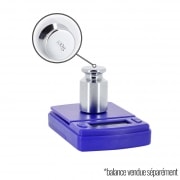
There is no scientific calculation as such to determine the weighing uncertainty of a precision scale. This will depend on several criteria, such as calibration, readability, density, reference mass, the result obtained, error, and many other factors.
Subsequently, the result obtained must be combined in equations in which other factors will need to be included. In other words, as you understand, this is an extremely specialized task, entrusted to calibration laboratories. On the other hand, depending on how you use your precision scale, the percentage of uncertainty could vary!