Français
 Italiano
 Deutsch
 Español
 Português

Since the end of 2017, vapers have been able to find a nicotine salt e-liquid in their shops or online. But what are nicotine salts? What effects do they have on vaping and health? And above all, who can consume them? Here is a small guide to tell you more about this new component.
If the product was specifically designed to attract these profiles, nicotine salt e-liquids are fully suitable for everyone. The primary targets will be those seeking a high nicotine level with the e-cigarette, without having to endure the unpleasant hit effects. Even vapers who also smoke find it satisfactory, particularly because they can now satisfy their craving very quickly, as if they were smoking a cigarette.
On the other hand, while these e-liquids are ideal for smokers wishing to switch to vaping, it is important to remember that products with atomizers should be avoided (this is especially true for experienced vapers).
It is better to favor products like podmods or clearomizers with indirect inhalation. Some products offering indirect inhalation will allow for a closer experience to smoking (the smoke is held in the mouth before being swallowed).
On the other hand, direct inhalation will propel the inhaled smoke directly into the lungs, without it staying in the mouth.
In terms of e-liquids, manufacturers set the bar very high. After CBD e-liquids, here are nicotine salt e-liquids. They are taking over specialized shops and attracting a real audience. Vaping now takes on healthier connotations. Indeed, present in tobacco leaves, nicotine salts are extracted in a more natural way. They are then mixed with of propylene and vegetable glycerin to give the crystals this liquid form that will be found in e-liquids.
Until now, e-liquids were made of so-called pharmaceutical nicotine. That is to say, it has been purified by human hands, giving it the property of being more easily absorbed by the body. Furthermore, its effect lasts over time. But on the other hand, this nicotine content is less than that provided by a cigarette.Simply put, you have to vape for 10 minutes to get what a cigarette gives you in 10 seconds.

Classic (pharmaceutical) nicotine becomes unpleasant starting at 12mg. This is noticeable through coughing fits and a tingling throat. Vapers are then led to use e-liquids with lower nicotine concentrations and therefore, to vape more, in order to feel "satisfied" in terms of nicotine levels.
Nicotine salts, being purer, offer a higher nicotine level, almost similar to that obtained from smoking a cigarette. Thus, the vaper is satisfied more quickly and therefore vapes less. On the other hand, at the time of consumption, they do not burn the throat like pharmaceutical nicotine. It is said that the “hit” is smoother and more pleasant, notably thanks to the presence of benzoic acid which lowers the pH level. Thus, the nicotine level is higher in e-liquids with nicotine salt than in those containing regular nicotine.
To put it simply: thanks to nicotine salt, the vaper will feel less need to vape, as they will get their nicotine quota in less time than with a regular e-liquid. This is why heavy smokers who now want to switch to e-cigarettes will have their nicotine needs met quickly thanks to nicotine salt. In summary, nicotine salt e-liquids are more concentrated in nicotine and provide a more pleasant hit than regular e-liquids.
The impact for the consumer is therefore twofold: providing the sufficient nicotine level for the vaper and helping them reduce their consumption. By spacing out vaping, this will allow them to use less e-liquid and therefore also save money! For the moment, the choice of e-liquid is quite limited. But this is tending to expand, in order to offer consumers a range almost similar to that of traditional e-liquids.
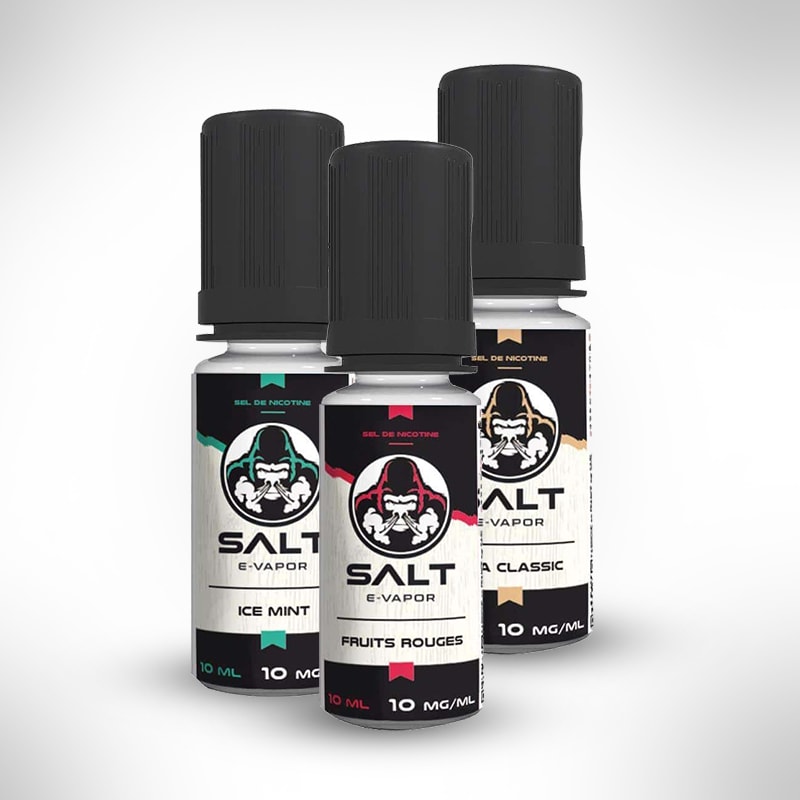
ÉBeing a fairly recent product, there is too little hindsight to know the repercussions on consumers' health. No studies have been conducted on nicotine salts, moreover. It is highly likely that, even if they are more "pure" than nicotine itself, the effects on the body are substantially identical. Specialists therefore believe that the risks are identical.